Population: 662 000
Area: 248 km²
Rivers: Main, Nidda
Location: 50° 07' N 08° 41' O
History
The first recorded mention of Frankfurt dates from an imperial assembly and church synod presided over by Charlemagne in 794. Situated at the crossroads of numerous European trade routes, Frankfurt began to emerge as one of the continent's most important trade and finance centres in the Middle Ages. Jewish sources dating from 1150 report on (autumn) fairs in Frankfurt.
In 1329, the Emperor Ludwig granted the city a second annual fair. From 1330 onwards, the spring fair became a hub for the continent's nascent import-export trade. Emperor Charles lV's Golden Bull confirmed Frankfurt as the location for the election of German kings. From 1562, Frankfurt supplanted Aachen as the city where Emperors were crowned. The city was capital of the German Confederation from 1816 until 1866, and the first freely elected German parliament convened in St Paul's Church in 1848-9. Frankfurt was extensively damaged in the Second World War, with the Old Town practically obliterated.

In 1949, Chancellor Konrad Adenauer narrowly prevailed with his choice of Bonn as capital of the new Federal Republic ahead of Frankfurt, which had even constructed a parliament building for the purpose. The building now houses the local state broadcaster. After many years of acrimonious debate, skyscrapers have become the defining element of the modern city. Alongside the Romer Town Hall, the skyline is the city's symbol and trademark. Frankfurt rates as a leading international finance and business centre, and boasts branches of more than 490 domestic and foreign banks, including the headquarters of Deutsche Bank and the European Central Bank. The ECB will move to a new skyscraper in the east of the city in 2012.

Portrait
The usual top-of-mind associations with Frankfurt are the airport, St Paul's church, Goethe, the German stock exchange, the Book Fair, skyscrapers - and sausages. The city offers a fascinating mix of opposites, a buzzing global crossroads combined with the charm of a village. Internationalism is Frankfurt's leitmotiv: almost a third of the citizens hail from outside Germany, but many districts remain homely to the point of introversion.

The half-timbered houses, narrow alleyways and timeless pubs of Sachsenhausen or Hochst, serving the locals' favourite Ebbelwoi or apple wine, conjure up something close to a rural idyll. However, big business is omnipresent in the banking quarter and the airport. The finance and insurance industries employ 70,000 staff. Just 12 kilometres outside the centre, another 70,000 or more work as civil servants, security personnel and retail staff at the airport, Germany's single biggest centre of employment.

Frankfurt is a globally significant trade fair and exhibition centre. The leading events include the Book Fair, first held in the 15th century, the IAA motor show, and Ambiente, the world's biggest consumer durables fair. The jewel in the city's cultural crown is Museumsufer, a series of outstanding museums ranged along the riverbank. Frankonovurd, the original name of the settlement, means ford of the Franks, indicating a section of the River Main shallow enough in medieval times to be crossed by wading.

Romerberg square and the 14th century Town Hall form the heart of the Old Town. By contrast, the unique skyline has prompted the nickname 'Mainhattan'. The Messeturm was the tallest building in Europe at 257 metres on completion in 1990, only to be supplanted seven years later by the 300-metre tall Commerzbank Tower. Plans are in place for further skyscrapers to shape the ever-modern skyline.
Sights:
Cathedral
St Paul's church
Stadel Museum
Alter Oper opera house
Palmengarten botanical gardens

Football
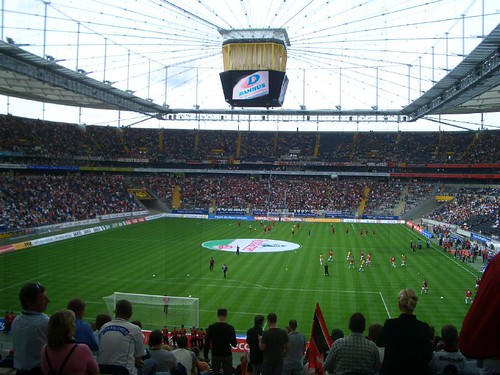
Frankfurt rates as the capital of German sport, home to leading organisations such as the German Football Association (DFB) and the German Olympic Sports Federation (DOSB). The citizens and their guests from all over the world will never forget the extraordinary atmosphere before, during and after the city's five 2006 FIFA World Cup™ matches at the Frankfurt Arena.

Frankfurt also staged five matches at the 1974 finals, including the Opening Match between Brazil and Yugoslavia, and a legendary battle in torrential rain between Germany and Poland. The stadium was also a venue for the 1988 UEFA European Championship and FIFA Confederations Cup 2005, including the Opening Match and the Final between Brazil and Argentina.

Eintracht Frankfurt boast one of the richest histories in German club football. Eintracht celebrated their greatest triumphs in winning the 1959 German championship and the 1980 UEFA Cup. Local heroes include 1974 FIFA World Cup winners Bernd Holzenbein and Jurgen Grabowski, and "Charly" Korbel, whose 602 appearances are a Bundesliga record. FFC Frankfurt have utterly dominated the Women's Bundesliga for many years, winning the league and Cup seven times apiece, and the UEFA Cup thrice. Far and away the country's most successful women's club, FFC Frankfurt have nurtured greats of the domestic and international game including Birgit Prinz, Steffi Jones and Silke Rottenberg.


 History Wolfsburg is one of the few new towns founded in Germany in the first half of the 20th century, and will be 70 this year. The city was specifically established to manufacture the VW Beetle, an iconic vehicle which was to become a symbol for all that was good about "made in Germany", and a shining example of Germany's prowess in automobile manufacturing.


 Posts
Posts


